
Project Maximus: The Mojave Desert, the Grasslands of Indiana – Why?
The Ground Truth: Parched Deserts and Paved Farmland
Look across the Mojave Desert and the rural grasslands of Indiana. You see thousands of acres cleared, leveled, and paved over for hyperscale data centers and sprawling energy fields. The sales pitch was simple: cheap land, wide-open space, and limitless digital growth.
The physical reality on the ground is completely broken.
High-density AI compute clusters run blazing hot, requiring millions of gallons of water every single day just to prevent hardware failure. In the Mojave, operators evaporate irreplaceable groundwater drawn from ancient, fragile aquifers in 115°F heat—burning through drinking water to cool chips. In the agricultural corridors of Indiana, fertile acreage and water tables are siphoned off to feed server yards. Meanwhile, the local utility grids are choked. Transmission lines to move power back to metropolitan centers are stalled in five-to-seven-year interconnection queues. The power is stranded, the water is vanishing, the land is locked up, and people are angry. Communities watch their local wells drop and dust kick up while high-voltage lines run right past their homes to feed server banks, delivering zero local benefit.
The question is simple: Why are we forcing digital infrastructure into parched deserts and productive heartland when energy, space, and cooling belong on the water?
The Breakbulk Advantage: Scale Without the Land War
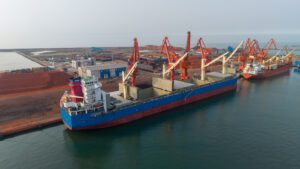
Project Maximus bypasses these mainland battles entirely by moving power and compute offshore aboard decommissioned commercial breakbulk vessels.
These are not small barges; breakbulk ships are massive industrial workhorses stretching over 600 feet long with cavernous, multi-story cargo holds. Instead of leveling pristine desert or farming acreage, a single repurposed vessel provides the internal volume and heavy deck-load capacity to house containerized Battery Energy Storage Systems (BESS) and high-density compute right at deepwater coastal ports.
Moored along the coast, these floating platforms tap into closed-loop seawater heat exchangers—saving millions of gallons of inland freshwater daily while delivering firm, rapid power directly where metro grids need it most.
Breakbulk vessels reach the end of their commercial seafaring lives just as ultra-class OTR tires reach the end of their haul-road duty. Instead of beaching these massive ships for low-yield scrap metal or abandoning 5-ton tires in open-pit mine graveyards, Project Maximus fuses both decommissioned assets into high-performance utility infrastructure:
-
Repurposed Marine Hulls: Retired breakbulk carriers provide the heavy displacement, boxed hold volume, and intact onboard cranes needed to host containerized BESS and substation switchgear right at coastal load centers—bypassing land acquisition and freshwater cooling entirely.
-
Intact Mining Elastomers: Sourced directly from extraction basins, un-shredded 5-ton OTR tires form heavy spindle berth fenders and continuous waterline bumpers around the hull, absorbing massive kinetic impact while lower-hold tire matrices serve as dynamic roll-dampening ballast.
-
Corridor Armor: Sliced tire treads sleeve the high-voltage export cables running from the ship across intertidal landings and rocky onshore trenches into metro grid interconnects.
-
A Complete Circular Pipeline: By routing mining rubber directly to regional shipyards to outfit decommissioned hulls, the system eliminates mining disposal liabilities, repurposes aging commercial tonnage, and delivers firm power to data clusters—without leveling an acre of heartland or draining a gallon of desert water.
-
Rethinking Energy and Industrial Footprints
The question is no longer whether we need more computing capacity—it is where we choose to put the burden. Leveling productive heartland and depleting fragile desert aquifers to power digital growth is a dead end. By repurposing spent industrial tonnage, we bypass the land crunch entirely and place massive energy platforms where cooling and buoyancy do the heavy lifting: underwater.